
How to Choose a Growth Marketing Agency for Ecommerce
SEO / AEO
Most ecommerce brands evaluate agencies on the wrong criteria: impressive case studies, polished pitch decks, industry awards. The agencies that actually drive compounding growth share a different profile. They structure accounts for iteration velocity. They integrate channels instead of siloing them. Their team model matches your stage. This playbook covers the red flags to spot, the questions that reveal operational maturity, and how to evaluate agency fit in your first 30 days.




Written & peer reviewed by
4 Darkroom team members
Written & peer reviewed by 4 Darkroom team members
TL;DR: Most ecommerce brands choose agencies based on portfolio aesthetics and pitch confidence, not operational fit. The agencies that compound growth align on account structure, channel integration, iteration cadence, and team model. This playbook gives you a framework to spot red flags during pitch, ask questions that reveal true operational maturity, evaluate the first 30 days, and structure the relationship for compounding returns. The best growth agencies aren't the most acclaimed. They're the ones built to iterate faster than your competition and adapt their service model to your specific growth stage. Darkroom exists to be that partner for ecommerce brands that want to scale profitably.
Why Your Current Agency Selection Process Is Broken
You've probably evaluated agencies the same way everyone else does. You ask for case studies. They show you screenshots of dashboard metrics with arrows pointing up. You ask about their process. They walk you through a deck that sounds like every other agency. You ask for references. They connect you with three brands that say nice things.
None of this predicts whether they'll actually drive profitable growth for your business.
Here's what's happening on the other side of the pitch. The agency sales team is incentivized to close the deal, not to screen for fit. They'll tell you they specialize in your vertical (they work with multiple verticals). They'll promise flexibility (they have a standard playbook). They'll say they integrate channels (they have separate reporting streams). They know the signals you're looking for. They've optimized their pitch to hit them.
Meanwhile, the team members who'll actually run your account are sitting silently in the background. The account structure that will determine whether they can iterate weekly or quarterly is already locked in. The team model that will make or break your ROI is already decided.
You're evaluating based on sales confidence, not operational maturity.
The Framework: Four Dimensions of Agency Fit
Operational fit breaks down into four dimensions. Every agency has a specific configuration on each. Some configurations work for certain growth stages. Working with a growth marketing services can help navigate this effectively. Others will suffocate your business.
1. Account Structure
This is how the agency organizes your paid media, content, and retention channels. Do they have one lead strategist who sees all your channels, or are they siloed by platform? Can they reallocate budget from Facebook to Google based on real-time performance, or does that require a meeting? Do they structure accounts for iteration velocity, or for reporting simplicity?
Good agencies structure accounts for fast iteration. Slower accounts are structured for heavy documentation and stakeholder alignment.
2. Channel Integration
Most agencies claim they're "omnichannel." What they mean is they offer services across channels. They don't actually integrate them. Your paid media team doesn't see your organic metrics. Your email team doesn't optimize based on your acquisition cost. Your Amazon team operates independently.
True integration means one budget pool, shared attribution data, and collaborative optimization. It's harder to execute. Most agencies don't do it.
3. Iteration Cadence
How often do they actually test and optimize? Weekly? Bi-weekly? Monthly? This directly correlates with growth rate. Agencies that iterate weekly compound faster because they catch winning patterns before they fade. Agencies that report monthly are inherently slower.
The agencies claiming weekly iteration often mean weekly reporting. Dig into what actually changes week to week.
4. Team Model
How do they scale people as your spending grows? Do they assign a fractional strategist from day one? Do they have a single account manager handling multiple clients? Do they pair junior talent with senior oversight? These decisions determine whether your account gets better over time or regresses.
The best team models match your growth stage. Early-stage brands need more strategy input and hands-on optimization. Mature brands need systematic scaling and channel expansion.
Red Flags in Agency Pitches
Once you know what to look for, the weak spots in an agency pitch become obvious.
Red Flag 1: Vague Case Studies
If a case study says "we grew revenue 150%" but doesn't specify time period, starting volume, or unit economics, that's marketing theater. Real case studies include context. They acknowledge constraints. They show where the agency's work mattered versus external factors.
Red Flag 2: Process Over Results
When an agency spends more time explaining their methodology than discussing your specific challenges, they're selling process, not outcomes. Understanding what makes modern agency models different helps clarify this distinction. They've built a standardized playbook and they want to run it regardless of fit. A good agency will ask you specific questions about your account structure, team, technology stack, and growth ceiling.
Red Flag 3: Separate Reporting Streams
If they show you separate decks for paid media, organic, and retention, that tells you those teams aren't integrated. They're minimizing handoff overhead by keeping channels separate. This is convenient for the agency. It's inefficient for your growth.
Red Flag 4: Large Historical Case Studies, Young Client Base
If their big wins are from 3-5 years ago but their current client list is all new, ask why. Did they lose momentum? Did previous clients churn? Did their team turn over? Historical wins don't guarantee current execution.
Red Flag 5: No Discussion of Team Depth
A red flag if they avoid talking about who will actually optimize your account. Instead they focus on "team access" and "dedicated support." That's fine. But who's the strategist making directional calls? What's their background? Have they run accounts at your scale before?
Questions That Reveal Operational Maturity
These questions are designed to move past pitch language and force the agency to reveal their real operational model.
Question 1: How Do You Structure Our Account for Iteration Speed?
Listen for whether they talk about feedback loops, testing frameworks, or just account hierarchy. Mature agencies will discuss how they organize campaigns to test quickly while maintaining statistical rigor. They'll talk about budget allocation mechanisms. They'll explain how they move budget between experiments.
Question 2: Walk Me Through How You'll Allocate Budget Across Paid Media, Organic, and Retention in Month One.
This forces them to show their integration process. If they need to schedule separate meetings with each channel lead, that's a red flag. A good agency leader will have a framework ready. Working with a paid media management can help navigate this effectively. They'll ask you questions about your current unit economics before they propose allocation.
Question 3: If You See a Major Performance Opportunity in a Channel We Aren't Currently Using, How Quickly Can You Test It?
The answer reveals their decision-making speed and flexibility. Bad agencies will say "we'd need to discuss it in our weekly standup." Good agencies will say "we'd test with 5-10% of budget while we align with you on strategy."
Question 4: Show Me How You Measure Whether Your Work Is Actually Driving Incremental Growth.
Most agencies can't answer this cleanly because it requires attribution rigor. Many rely on platform metrics that mask real performance that's hard to execute. A good agency will talk about control groups, incrementality testing, or careful comparison of account performance to category benchmarks. If they just point to correlation between their work and revenue growth, that's weak.
Question 5: What's Your Process for Identifying Underperforming Tactics and Killing Them?
Agencies that compound growth are ruthless about discontinuing tactics that don't work. They don't try to make everything work through optimization. Bad agencies will optimize a losing tactic into oblivion. Good agencies will kill it in a week and reallocate budget.
Evaluating the First 30 Days
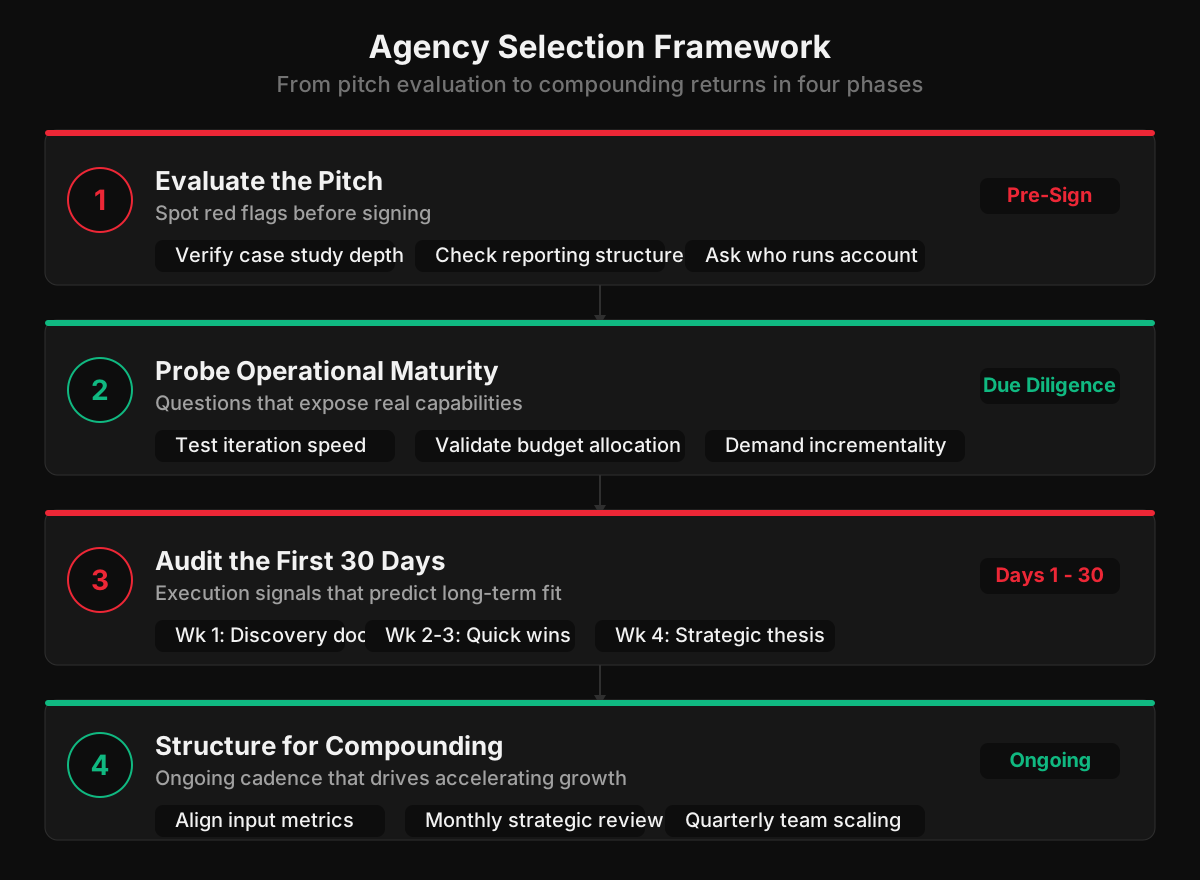
The pitch is over. They've signed the SOW. Now comes the critical period where you decide whether this agency actually executes. Most agency-brand relationships break within 90 days, so early signals matter or whether you just hired a more expensive version of the last one.
Week 1: Account Setup and Discovery
A mature agency will spend week one asking questions, not implementing changes. They're mapping your tech stack, understanding your current performance baseline, and identifying data gaps. By the end of week one, you should have a written discovery doc that shows they actually understand your business. If they're already running optimizations, they moved too fast.
Week 2-3: Foundation Layers
They should identify low-hanging fruit in your current setup (account structure improvements, conversion rate wins, attribution fixes) and test them. These aren't flashy. They're the foundation for faster iteration. They should communicate weekly on what they're learning, not what they're implementing. Ask them what they're surprised by. Good agencies are always surprised by something.
Week 4: Strategic Recommendation
By end of month, they should present a strategic recommendation for the next quarter. This isn't a prescriptive plan. It's a thesis with supporting data: "Here's what we learned. Here's what we think you should prioritize. Here's how we'd structure it." It should be specific enough that you can evaluate whether they actually understand your business.
What to Watch For
Are they asking for more context than you expected? That's good. Are they avoiding hard conversations about the limits of your current setup? That's bad. Are they showing you actual data, or are they making assertions? Are they explaining why something worked, or just pointing at the results?
Structuring the Relationship for Compounding Returns
The best agency relationships aren't transactional. Working with a performance creative can help navigate this effectively. They're structured to improve over time as the agency learns your business.
Align on Success Metrics Early
Not revenue or ROAS. Those depend on factors outside the agency's control. Align on inputs: testing velocity (number of tests per week), iteration quality (conversion rate of tests), and integration depth (budget movement across channels). These are controllable. They predict compounding growth. The same principle applies when evaluating performance creative capabilities.
Build a Monthly Strategic Review
Don't let reporting become a one-way stream. Use monthly reviews to pressure-test strategy. Bring cross-functional stakeholders. Ask the agency to defend their allocation decisions. This keeps them sharp and ensures they're thinking about your business holistically.
Evaluate the Team Model Quarterly
As your volume grows, the team that was right for you in month one might be undersized in month four. Good agencies will bring this up unprompted. They'll recommend adding capacity before you need it. Bad agencies will stretch themselves thin and your account performance will regress.
Demand Transparent Budget Allocation
You should be able to see exactly how much of your budget is going to experimentation, sustainment, and scaling. This changes over time. In early months, more should go to experimentation. As winners emerge, more flows to scaling. This rebalancing is how growth compounds.
The Integration Question: Why Most Agencies Fail
Here's where most ecommerce growth agencies plateau.
An agency good at paid media will optimize Facebook and Google separately. They'll improve ROAS on each. But they won't think about what happens when you reallocate 20% of Facebook budget to Google. They won't model how that changes your customer acquisition curve. They won't optimize across channels.
An agency that adds retention marketing to its service offering often treats it as a separate line item. Retention budget competes with acquisition budget in resource allocation, but they're not structured to make that trade-off systematically. They'll optimize each channel but not the system.
The agencies that break through to real compounding growth are ones that:
1. Structure accounts so budget flows to the highest-ROI activity regardless of channel
2. Build team models where the strategist thinking about top of funnel also understands repeat purchase economics
3. Iterate across the entire customer lifecycle, not individual channels
4. Measure incrementality at the business level, not the campaign level
This requires operational maturity. It requires a different team structure. It requires a different business model. Most agencies haven't made that shift because it's harder to sell and harder to execute.
The Expanded Agency Model: Multi-Channel vs. One-Channel Shops
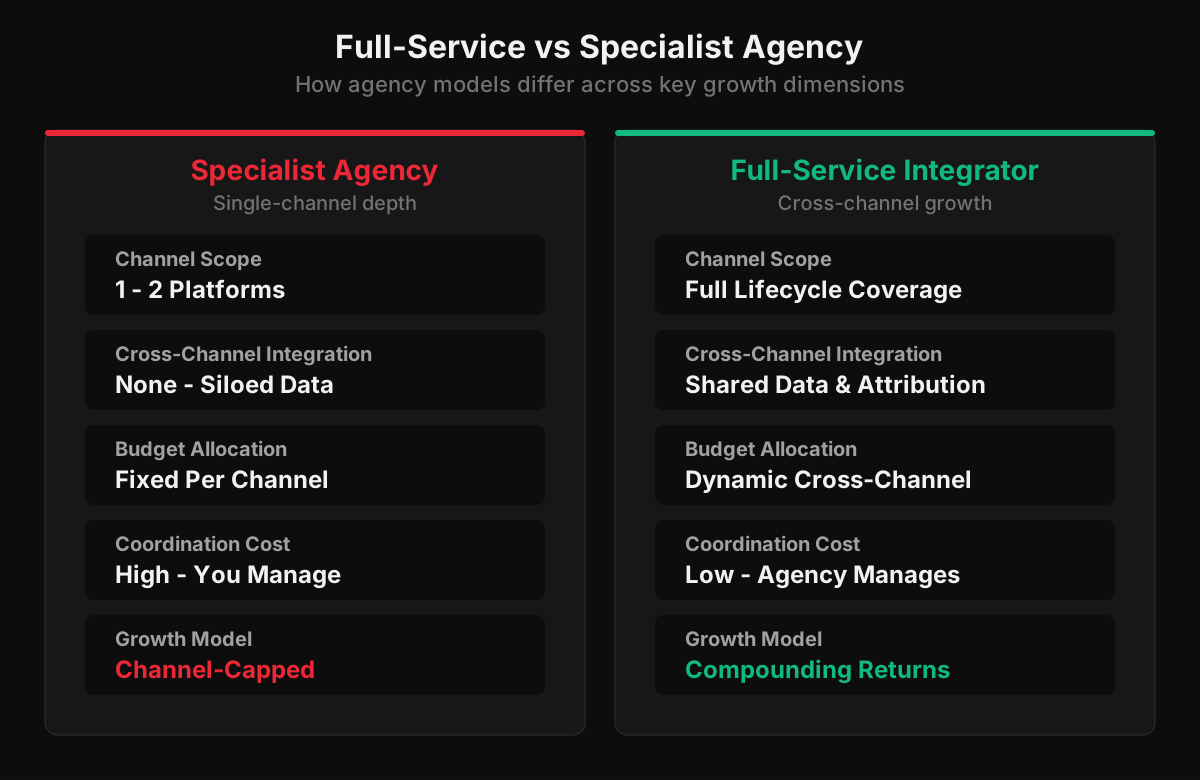
When you're evaluating agencies, you'll encounter two archetypes: specialists and integrators.
Specialist Agencies
They do one channel exceptionally well: paid media, or organic, or Amazon. The benefit is deep expertise in that channel. The cost is that they don't optimize across channels. You'll end up with a specialist agency for each channel, which creates coordination costs and budget competition nobody's managing.
Integrator Agencies
They're smaller and have less depth in any single channel, but they think about your growth holistically. They're rare because it's harder to build that capability. But when it works, you get strategic compounding instead of channel-by-channel optimization.
Most ecommerce brands start with specialists because specialist shops are easier to evaluate and easier to transition away from. But as you scale, you hit a ceiling. You end up optimizing channels in isolation while missing the architecture of your growth system. That's when you realize you need an integrator model, which means switching agencies and rebuilding institutional knowledge all over again.
Frequently Asked Questions
Q: How long does it take to see real results from a new agency?
A: The honest answer is six weeks minimum if they're actually good, and they're not just riding your existing momentum. They need time to understand your baseline, test their hypotheses, and iterate. If they're promising month-one results, they're not doing discovery. That's a red flag.
Q: What's the right fee structure? Performance-based, retainer, or hybrid?
A: Avoid pure performance-based relationships. They incentivize short-term volume over sustainable growth. Avoid pure retainers with no alignment on results. Hybrid is best: reasonable retainer for the work, bonus for exceeding agreed metrics. The retainer should scale with volume.
Q: Should we hire an agency or build in-house?
A: This depends on your stage. If you're under 10 million in revenue, outsourcing lets you focus on product and operations. If you're scaling past 20 million, you probably need in-house capability managing the agency. The best model often isn't binary. You build internal strategy and use the agency for execution and specialized areas.
Q: How do we ensure the agency actually tests and iterates, not just optimizes existing campaigns?
A: Track testing velocity: number of new tests launched per week. Look at test pass rate (what percentage actually work). Ask in monthly reviews: "What new hypothesis are we testing this month?" The agencies that compound growth are launching 10+ tests weekly by month three.
Q: What's a reasonable budget to give an agency to prove themselves?
A: Give them meaningful budget from day one (at least your current spend or close to it), but structure it with a 60-day evaluation point. By day 60, you should see evidence of better account structure, faster iteration, or higher incremental ROI. If you don't, they might not be a fit.
Q: How do we know when to switch agencies?
A: When they stop iterating. When the team that sold you changes. When your account performance plateaus for two consecutive months with no good explanation. When they're unable to answer strategic questions about your business. You're not paying for past success. You're paying for future growth.
Evaluating a growth marketing agency for your ecommerce business? Book a call with Darkroom to see how integrated channel strategy can compound your growth.
EXPLORE SIMILAR CONTENT

ROAS Calculation: A Complete Guide To Measuring Ad Performance

Amazon Prime Day 2025 Recap: CPG Sales Insights & Growth

Cracking the Algorithm: Maximizing TikTok Shop LIVE Sales in 2026

Website Speed Optimization: The Definitive Guide To Faster Performance

The Buyer’s Journey Simplified

How to Evaluate Acquisition Channels

How To Be The ‘CMO’ Before Hiring a CMO

Establishing Company Culture

Bracing for Seasonality & Cash Flow

Setting Targets & Tracking Goals

Establishing North Star Alignment

Data Infrastructure for Brands doing <$1m

Finding Customers for your Product

Elements of Growth Marketing

Targeting Customers with the Right Channels

Advanced Amazon Keyword Research Methods For 2026

TikTok Ads: How To Create, Optimize, And Scale Campaigns

How Instacart Works: The Definitive Guide For Shoppers And Stores

Retention Marketing 101: Definition, Benefits, and Strategies

Retail Media Networks: What You Need to Know in 2025

How to Launch Your Business on Walmart Marketplace Successfully